|
| Research article - (2026)25, 303 - 313 DOI: https://doi.org/10.52082/jssm.2026.303 |
| Lower Limb Muscle Synergies During Table Tennis Forehand Topspin Stroke: A Muscle Synergy Theory-Based Analysis |
Rui Zhao, Yi Xiao |
|
Narrated in English
|
 |
| Key words: Table tennis, muscle synergy, non-negative matrix factorization, lower limb, motor module, temporal activation |
| Key Points |
|
|
|
| Participants |
Ten right-handed male table tennis players were randomly recruited from China Table Tennis College (Age: 20.70 ± 2.00 years; Height: 177.80 ± 5.80 cm; Weight: 71.75 ± 7.54 kg; Training experience: 12.80 ± 2.96 years; Skill level: National Grade one). The handedness of players was established according to which hand was used to hold the racket, and the foot on the same side with the handedness was considered as the footedness (Peters and Murphy, |
| Data collection instruments |
To investigate lower limb muscle synergy during forehand topspin strokes in table tennis players, both kinematic and electromyographic (EMG) data were collected. The experimental ball was DHS D40+ (3-star) of Double Happiness Company (DHS). The table and rackets used in this experiment were Rainbow table made by DHS and Timo Boll-ZLCarbon, separately. The racket was wrapped with red rubber on one side while black on the other side. A Serving machine (V-989H, Nittaku) was employed for ball delivery at a frequency of 25 balls per minute, with parameters set as follows: upper wheel rotation speed at level 7 (10-level scale, higher numbers indicating faster speed) and lower wheel rotation at level 3. And it was positioned approximately 30-40 cm directly behind the center of the table’s end line, with the ball outlet around 100 cm above the ground. Kinematic data were collected using a Qualisys 3D motion capture system (Oqus700+, Qualisys, Gothenburg, Sweden) at 200 Hz sampling frequency. A total of 50 reflective markers (14mm diameter infrared spheres) were attached to participants. The captured motion data were processed in Visual 3D software (C-Motion, Inc., Germantown, MD, USA) for modeling, with the stroke process divided into three phases: (A) backswing, (B) forward, and (C) backward ( |
| Experimental set up |
The experiment was conducted in the Biomechanics Laboratory at Shanghai University of Sport. The Qualisys 3D motion capture system and NORAXON surface electromyography (sEMG) system were used to synchronously collect kinematic data and lower limb muscle EMG data during table tennis players’ forehand topspin strokes. The two systems were synchronized using a trigger synchronization box. The experimental setup was shown in |
| Experimental protocol |
The experimental flowchart was illustrated in |
| Data analysis |
The EMG signals were processed using MATLAB software (MathWorks, 2024b, USA). The EMG signals from the eight muscles were processed through the following steps: band-pass filtering (20-450Hz), high-pass filtering using a fourth-order digital Butterworth filter with a cutoff frequency of 40 Hz (Messier et al., |
| Non-negative Matrix Factorization (NMF) | ||||
The non-negative matrix factorization (NMF) algorithm was employed to analyze muscle synergies from surface electromyography (sEMG) signals in this study. The EMG signals from eight muscles were normalized to balance the variability of muscle activity levels, facilitating subsequent extraction of motor module composition and their temporal activation patterns. The analysis was performed using MATLAB's Statistics and Machine Learning Toolbox, following the mathematical model proposed by d'Avella (d’Avella et al.,
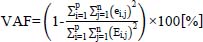
This study adopted a multi-dimensional optimization approach to comprehensively evaluate computational results across different numbers of motor modules (ranging from 1 to 7) to determine the optimal number of modules. The algorithm's termination conditions were set as follows: the computation ceased when either the sum of squared reconstruction errors fell below 10-6 or the number of iterations reached 500 (Israely et al., The VAF was calculated using the following formula:
Here, Ei, j corresponds to the actual EMG signal of the i-th muscle channel at time sample j, while ei,j represents the reconstructed EMG signal generated from the linear combination of synergy activation coefficients and synergy vectors. The parameters p and n are the number of muscle channels and time samples, respectively. The numerator sums the squared residuals between the original and reconstructed signals across all muscles and time points, whereas the denominator reflects the total variance in the original EMG data. |
| Cluster analysis |
Based on the similarity of muscle composition, the motor modules of 10 athletes were clustered using k-means analysis (Steele et al., |
| Testing the similarity of motor module composition |
Cosine similarity (CS) analysis was employed to examine the similarity of motor module composition among athletes (Hagio et al., |
| Temporal activation patterns |
The similarity of temporal activation patterns among athletes was calculated using the same method as for motor module composition similarity. The contribution of each cluster to each stroke phase was determined by calculating the percentage of the area under the activation curve (activation area) for each phase relative to the total activation area. |
| Statistical analysis |
All statistical analyses were performed using SPSS 26.0 (IBM Corp., Armonk, NY, USA), with the significance level set at α = 0.05. The Friedman test was employed to analyze the differences in module composition and temporal activation pattern similarity among clusters, as well as the differences in activation area across different stroke phases within each cluster. Bonferroni correction was applied for multiple comparisons. |
|
|
| Number of motor modules |
The EMG activities were analyzed using non-negative matrix factorization (NMF), and the average VAF values for 1-7 motor modules across all 10 athletes were calculated, as shown in |
| Composition of the motor modules |
The optimal number of clusters (k) was determined by calculating silhouette scores for different k-values in the cluster analysis (Oliveira et al., Based on the optimal clustering results, the composition of the three identified motor modules was further analyzed, as shown in |
| Inter-individual similarity of motor module composition |
The similarity of motor module composition among all athletes was evaluated using cosine similarity (CS) analysis, with the results presented in Friedman test was used to compare the distributions of cosine similarity (CS) values between two individual athletes within each cluster, with the results presented in |
| Temporal activation pattern |
The temporal activation patterns corresponding to the motor modules, as derived via the NMF algorithm, were shown in |
| Inter-individual similarity of temporal activation patterns |
The similarity of temporal activation patterns among all athletes was evaluated using cosine similarity (CS) analysis, with the results presented in |
| Activation areas of different clusters across different stroke phases |
Friedman test was used to compare the differences in activation areas among clusters across different stroke phase, with the results presented in |
|
|
This study employed NMF-based muscle synergy analysis to extract three fundamental motor modules underlying lower limb muscle activity during forehand topspin strokes in table tennis players. The results indicate that all athletes' lower-limb synergy patterns can be categorized into three functional clusters, with the silhouette score from cluster analysis confirming the validity of this classification. This suggests that the CNS primarily simplifies motor control through these three basic modules (Mussa-Ivaldi, Cluster 1 consists of the RF and VM, which primarily contribute to hip flexion and knee extension. The activation peak of this cluster occurred during the mid-to-late forward phase when the right (supporting) leg rapidly transitions from slight flexion to extension. The RF and VM work synergistically to extend the knee joint while coordinating with hip joint movements to shift the center of gravity forward, thereby optimizing the efficiency of ground reaction force generation. Notably, the RF serves as the dominant muscle, generating upward and forward trunk motion to provide the primary power source for the forward stroke. Cluster 2 comprises the GMax, GMed, BF, and TA, reaching peak activation during the early forward phase. These muscles primarily contribute to hip extension and external rotation. Specifically, the GMax and BF work synergistically to drive hip extension and external rotation, generating vertical ground reaction forces, while the TA assists in ground push-off production through dorsiflexion control. During the early forward phase, the right ankle rapidly transitions from dorsiflexion to plantarflexion. While the LG and Sol dominate explosive plantarflexion, the TA modulates plantarflexion speed through eccentric contraction to prevent excessive foot inversion, ensuring efficient force transfer along the sagittal plane. Additionally, the GMed maintains pelvic stability in the coronal plane via hip abduction torque, preventing trunk lateral tilt and ensuring swing trajectory precision. These findings align with Le Mansec (Le Mansec et al., Cluster 3 consists of the LG and Sol, exhibiting a double activation pattern during the backswing and backward phases. During the backswing phase, the Sol maintains arch tension through isometric contraction while pre-activating ankle plantarflexion potential energy. Concurrently, the LG regulates knee flexion velocity through mild eccentric contraction to store elastic energy. In the backward phase, this module was reactivated: the LG and Sol work synergistically through eccentric contraction to absorb landing impact forces. This synergistic mechanism not only achieves efficient energy dissipation but also provides essentially dynamic stability for consecutive strokes. These findings corroborate the study of He (He et al., The results revealed that seven of the ten athletes used three synergy patterns during the forehand topspin stroke, while the other three used only two of the three patterns. According to the muscle synergy theory (Mussa-Ivaldi, Inter-cluster comparisons revealed high inter-individual similarity in motor module composition across all clusters, whereas temporal activation patterns exhibited lower similarity. This finding is consistent with the muscle synergy theory (Mussa-Ivaldi, From the perspective of temporal activation patterns, table tennis forehand topspin strokes exhibit multi-peak activation patterns similar to badminton smashes (Barnamehei et al., This study confirms that during forehand topspin strokes, table tennis players' lower limb muscle activity is organized into three motor modules, demonstrating temporal characteristics of multiple activations within a single movement cycle. Through precise temporal coupling and intensity modulation, these modules achieve coordinated force production, forming an efficient energy transfer chain. This research reveals that while maintaining a standardized lower-limb movement structure, athletes can optimize movement economy and stroke effect by finely regulating temporal parameters. This regulatory ability is particularly evident during the multi-module coordination and potential-to-kinetic energy conversion in the forward phase. The study translates the abstract concept of "coordination" into two quantifiable dimensions, spatial modules and temporal activation, providing coaches with both a theoretical framework and practical guidance for precisely diagnosing technical deficiencies and implementing personalized training programs. |
|
|
During table tennis forehand topspin strokes, the lower limb muscles exhibited three fundamental synergistic patterns: (a) Rectus femoris (RF) and vastus medialis (VM); (b) Gluteus maximus (GMax), gluteus medius (GMed), biceps femoris (BF), and tibialis anterior (TA); (c) Lateral gastrocnemius (LG) and soleus (Sol). The three synergy patterns demonstrate phased specialization, activate multiple times within a single cycle, and work together in a dynamic interplay: during the backswing phase, all three synergies were co-activated, while the forward phase was dominated by Synergies 1 and 2, and the backward phase was solely controlled by Synergy 3. Athletes can optimize performance by precisely adjusting temporal parameters while maintaining a standardized lower-limb movement structure, a regulatory capability particularly evident during the forward phase. |
| Practical implications |
This study reveals that athletes can achieve stable forehand topspin strokes through coordinated activation of three lower-limb motor modules. Therefore, modular training is recommend to enhance stroke quality, such as strengthening RF/VM via weighted leg extensions, activating GMax/GMed via single-leg deadlifts, and developing LG/Sol using box jump exercises. Based on the finding that athletes achieve coordinated force generation through timed coupling of three lower-limb modules, training programs should emphasize the development of multi-peak activation capability, particularly focusing on rapid recovery after the stroke and preparation for consecutive force generation. For example, continuous attack training combined with footwork drills can effectively develop an athlete's ability to maintain kinetic chain integrity and achieve efficient recovery during dynamic movements. Research indicates that athletes enhance performance by regulating muscle activation timing and intensity. A phased training approach is recommended: beginners should first establish proper activation patterns through standardized drills, then progressively refine temporal control using variable-rhythm and randomized delivery training. This methodology helps to develop individualized neuromuscular control strategies while maintaining technical standardization. |
| Limitations |
This study only selected ten male table tennis players. This may present certain limitations in terms of sample representativeness and the generalizability of the conclusions. Future research should include a larger sample size and investigate the muscle synergies of both male and female players. This study only analyzed the muscle synergies in the lower limb of the racket-holding side. Future research could also include both lower and upper limb muscles to provide a more comprehensive understanding of whole-body coordination patterns. This study did not collect stroke effect data. Future research could simultaneously record the stroke outcome data to further analyze the relationship between the muscle synergy patterns and stroke effect. |
| ACKNOWLEDGEMENTS |
The authors would like to thank the subjects from China Table Tennis College of Shanghai University of Sport for their friendly cooperation in the kinematic and EMG data collection tests. The datasets generated during the current study are not publicly available but are available from the corresponding author upon reasonable request. The authors declare that they have no conflict of interest. All experimental procedures were conducted in compliance with the relevant legal and ethical standards of the country where the study was carried out. The authors declare that no Generative AI or AI-assisted technologies were used in the writing of this manuscript. |
| AUTHOR BIOGRAPHY |
|
| REFERENCES |
|




 Aoyama, T., Ae, K., Kohno, Y. (2022) Interindividual differences in upper limb muscle synergies during baseball throwing motion in male college baseball players. Journal of Biomechanics 145, 111384.