|
| Research article - (2026)25, 714 - 727 DOI: https://doi.org/10.52082/jssm.2026.714 |
| Analysis of The Differences Between Training Matches and International Competitions for Elite Chinese U15 Female Table Tennis Players |
Shuangying Wang, Hui Zhang |
|
Narrated in English
|
 |
| Key words: Table tennis, training match, international competitions, technical and tactical analysis |
| Key Points |
|
|
|
| Match Sample |
This study selected 80 matches involving five elite U15 female players from the Chinese National Youth Team in 2024 as the sample, including 40 training matches (20 wins, 20 losses) and 40 international competitions (20 wins, 20 losses). They were ranked 2nd, 3rd, 4th, 9th, and 25th, respectively, in the ITTF U15 Girls' World Rankings on June 4, 2024. The mean age, height, and body weight of the five female players were 14.56 ± 0.62 years, 162.6 ± 0.05 cm, and 56.8 ± 6.69 kg, respectively. All players adopted a shakehand offensive playing style, with four being right-handed and one left-handed (the players’ stroke techniques and ball placement were recorded according to forehand and backhand strokes; therefore, data from right- and left-handed players could be pooled and analyzed together). The 40 training matches primarily involved the aforementioned five national youth team players competing against other team players or each other. The 40 international competitions were official matches where these five players competed against players from countries including South Korea, France, Australia, India, Portugal, Slovenia, Ukraine, Singapore, Kazakhstan, Poland, and regions such as Chinese Taipei and Hong Kong, China. All matches were conducted in a best-of-five format. To control for the potential influence of match outcomes on technical and tactical behavior, the numbers of winning and losing matches and games were matched between the training matches and the international competitions ( The data used in this study were obtained from semi-public training matches and official World Table Tennis broadcasts. Training match videos were routinely recorded by coaches and players as part of the standard training process and later used for performance analysis with authorization from team management. Training matches were commonly observed by team managers, invited referees, training-base staff, and local youth players. As all participants were underage players, informed consent was obtained from both the players and their legal guardians, and approval for data use was granted by the coaching staff. All data were fully anonymized and included only match-related technical and tactical variables without any personal identifiers. The study involved retrospective analysis of non-identifiable observational data from routine training and publicly available matches, with no intervention or direct interaction with participants; therefore, in accordance with institutional ethical guidelines, formal ethical approval was not required. |
| Performance indicators |
The performance indicators in this study were of four types: stroke sequence, stroke technique, ball placement and rally outcome, as shown in In table tennis, the first four strokes of a rally exhibit the greatest technical and tactical variability and carry the highest tactical significance (Zhang et al., Stroke technique indicators were recorded in accordance with established observational frameworks from previous research (Zhang and Hohmann,
Ball placement variables shown in Rally outcomes were classified into two categories:
The objectivity of all observational indicators was ensured by using a previously validated coding system developed by Zhang and Zhou ( |
| Scoring rate, usage rate, and technique effectiveness formulas | ||||||||||||||||||||||||||||||
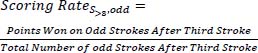
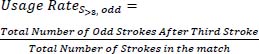
The usage rate of the
This usage rate is the proportion of odd-numbered strokes after the third stroke in the service sequence among all strokes in the match, as shown in
This usage rate is the proportion of even-numbered strokes after the fourth stroke in the receive sequence among all strokes in the match, as shown in
Usage Rate of stroke technique
|
| Heat map analysis Heat map algorithm |
||||||
Data were collected on players’ ball placement distribution during the first four strokes, after the third stroke, and after the fourth stroke, as well as on the corresponding technical usage of each stroke by the opponents, thereby forming a “placement→technique” combination. The matrix calculation (
To account for differences in the number of stroke-level opportunities across matches and rally stages, the logarithm of the total number of opportunities (total_strokes) was included as an offset. This specification allowed comparison of usage rates per stroke opportunity rather than raw frequencies (Frome and Checkoway,
P values were adjusted for multiple testing across technique categories within each phase using the Benjamini-Hochberg FDR method (Benjamini and Hochberg, |
| Generalized estimating equations regression models | ||||||
Dependent variable: WP (continuous variable) Independent variables: stroke effectiveness of each stroke Cluster: athlete ID Link function and distribution: identity link, Gaussian distribution Working correlation structure: exchangeable (assumes constant correlation between residuals of any two matches from the same athlete) The resulting marginal model is given in
Dependent variable: winning probability (continuous) Independent variables: stroke technique effectiveness Cluster: athlete ID Link function and distribution: identity link, Gaussian distribution Working correlation structure: exchangeable The full GEE marginal model was specified as follows (
All regression analyses were performed using SPSS 27.0 with robust covariance estimation and an exchangeable working correlation matrix; coefficient estimates, 95% confidence intervals, and p values are reported for all nine predictors. |
|
|
| Analysis of scoring rate, usage rate, and technical effectiveness |
| Heat map analysis of “placement→technique” combinations |
As shown in For the first stroke, IC showed higher usage rates than TM in four combinations: sf→TW (IC: 1.8%, TM: 0.4%; β = -1.536, RR = 0.215, adjusted p < 0.001), lm→TA (IC: 13.4%, TM: 8.7%; β = -0.459, RR = 0.632, adjusted p < 0.01), lb→TA (IC: 7.3%, TM: 4.7%; β = -0.464, RR = 0.629, adjusted p < 0.001), and lb→PU (IC: 0.7%, TM: 0.3%; β = -0.914, RR = 0.401, adjusted p < 0.05). For the third stroke, the combination lm→BL (IC: 10.8%, TM: 6.5%; β = -0.492, RR = 0.612, adjusted p < 0.01) showed significantly higher usage rates in IC than in TM. From Conversely, IC had higher usage rates for the second stroke combinations lm→BL (IC: 2.4%, TM: 0.8%; β = -1.151, RR = 0.316, adjusted p < 0.01), lb→TA (IC: 32.4%, TM: 25%; β = -0.268, RR = 0.765, adjusted p < 0.001), and lm→TA (IC: 29.4%, TM: 25.2%; β = -0.156, RR = 0.856, adjusted p < 0.05). the fourth stroke combination lm→BL (IC: 5%, TM: 2.6%; β = -0.524, RR = 0.592, adjusted p < 0.05), and the combination lb→TA (IC: 31.4%, TM: 23.6%; β = -0.286, RR = 0.751, adjusted p < 0.05) after the fourth stroke. As shown in Although the generalized estimating equation (GEE) yielded statistically significant test results (adjusted p < 0.05) based on this data pattern, there were cells with zero events in any comparison group. This situation is defined as “complete separation”, for which the statistical estimation is invalid (Heinze and Schemper, |
| Generalized estimating equations regression analysis Analysis of the model relating stroke sequence effectiveness to match winning probability |
| Analysis of the model relating technique effectiveness to match winning probability |
|
|
This study examined the contextual characteristics of technical and tactical behaviors in training matches versus international competitions among elite Chinese U15 female table tennis players. The results show that the differences between the two contexts are not mainly reflected in isolated technical indicators, but rather in the functional organization of stroke sequences, tactical combinations, and their contribution to match wins. This finding has direct practical implications for training: training design should shift from repetitive isolated technique practice to targeted simulation of competitive demands, placement preferences, and rally structures. This interpretation is consistent with the theoretical framework of table tennis performance analysis, which emphasizes the interaction among technical execution, tactical intention, and contextual constraints (Fuchs et al., |
| Heat map analysis of “placement→technique” |
Heat map analysis identified clear differences in tactical organization across contexts. In training matches, players significantly prefer to hit the ball to the opponent’s middle and forehand short areas, limiting the opponent’s high-quality attacks and forcing conservative returns, thereby creating conditions for their own subsequent attacks. This finding is consistent with Lanzoni et al. ( In contrast, in international competitions, players tend to hit the ball to the opponent’s backhand and middle long areas, leading to backhand-to-backhand rallies. This trend partially supports the conclusion of Zhang and Zhou ( This difference may be related to decision‐making under different competitive contexts. Although psychological pressure was not directly measured in this study, evidence shows that the psychological pressure in official matches is much higher than in training environments (Murphy et al., |
| Stroke sequence effectiveness and match winning probability |
There is a systematic difference in the influence of stroke sequence on winning probability between the two competition contexts. In training matches, the technical-tactical effectiveness of strokes 1 to 4 is the most significant determinant of match outcomes. In contrast, in international competitions, the influence of strokes after the third stroke on winning probability is significantly stronger, and their importance exceeds that of the first four strokes. This result is highly consistent with the findings of Tamaki et al. ( |
| Technique effectiveness and match winning probability |
At the technical level, serve, push, and topspin/attack consistently contributed to match winning probability across contexts, confirming the central tactical role of serve initiative (Lanzoni et al., In contrast, attacking techniques such as topspin/attack contributed more to match winning probability in international competitions than in training matches. Facing unfamiliar international competition environments and opponents’ playing styles, active attacking or quickly entering topspin rallies becomes a more stable scoring pathway-because unfamiliar opponents are less accustomed to one’s own stroke patterns, and the element of surprise in active attacks yields higher returns. At the same time, active attacking reduces the opponent’s reaction time and relieves one’s own defensive pressure. These findings are consistent with Lanzoni et al. ( Based on the above discussion, coaches and players should proactively simulate the competitive environment of international competitions in training (e.g., adding crowd noise, etc.) to help players adapt to the pace and competitive demands. When preparing for international competitions, youth training should appropriately increase the proportion of practice focused on proactively entering rallies from the backhand side, and should emphasize technical-tactical skills that facilitate a quick transition into rallies during the early service and receive phases. These include long serve tactics, receive-and-push followed by defensive counter-attacks, etc., thereby enhancing players’ tactical transition and adaptability in real matches. |
| Application and examples |
The heatmap results of this study show a clear difference in “placement→technique” combinations between training matches and international competitions: in international competitions, the rally combination in the backhand long area contributes more to winning probability. This finding can be directly applied to post‐match analysis-coaches and players can quickly identify winning patterns and tactical problems by examining “placement→technique” combinations on a heatmap. Take two international competitions between target player A and player B as an example. Player A lost the first match 2-3 but won the second 3-0. After the first match, a heatmap analysis of stroke “placement→technique” combinations were conducted to provide targeted recommendations for the player and coaching staff. The analysis shows that in the second match, player A significantly increased the frequency of placing the ball to the opponent’s middle and backhand long areas, thereby forcing the opponent to reply with topspin/attack and entering a backhand‐dominant rally rhythm. This supports the core conclusion of this paper: actively constructing a rally strategy in the backhand long area has a positive effect on match outcomes in international competitions. Therefore, it is recommended that players specifically strengthen their backhand stalemate ability in training, and use heatmaps after each international competition to quickly review their own “placement→technique” usage rates, enabling data‐driven tactical adjustments. |
| Selection of statistical methods for the study |
This study did not use traditional t-tests or nonparametric tests (e.g., Mann-Whitney U, Wilcoxon). Instead, it selected the generalized estimating equation (GEE) for the following reasons. First, the data structure is special. The data have repeated measures (multiple matches from the same athlete). Traditional tests require independent observations, but repeated data have intra-cluster correlation. Ignoring it leads to biased standard errors and increased Type I error. GEE captures this correlation via a working correlation matrix, yielding reliable estimates (Zeger and Liang, Second, the research goal matches GEE. This study aims to estimate the population-averaged effect of five athletes. GEE provides a population-average model (Gueorguieva, Third, GEE is robust. GEE is a semiparametric approach. It does not require specifying the full joint distribution of observations, only the marginal mean model. Even if the working correlation matrix (e.g., exchangeable structure) is misspecified, as long as the mean model is correct, the regression coefficients remain consistent. Moreover, the standard errors can be corrected using a robust sandwich variance estimator (Zeger et al., In summary, given the repeated-measures design and the need for population-effect inference, GEE better reflects the underlying data structure. Therefore, GEE was chosen as the main analytical method for this study. |
| Limitations |
The sample in this study was limited to Chinese U15 female players, and therefore the results may not be generalizable to other age groups or genders. Future research could expand the study population to include youth male players as well as elite adult male and female players, and could also incorporate comparisons of physical fitness and psychological factors. This would help make training matches more comparable to international competitions, thereby enhancing the effectiveness of training for elite table tennis players. Although training and formal competition are closely related in terms of performance objectives and technical demands, they constitute fundamentally different contextual environments, and multiple factors may influence players’ technical and tactical decision-making processes within them. First, individual differences in playing style may lead players to adopt different technical and tactical choices across contexts. Second, in training settings, players are typically familiar with their training partners, and such familiarity may alter tactical judgment and behavioral patterns. Third, compared with training environments, formal competition is generally associated with higher competitive intensity and may involve greater psychological demands; these contextual differences may further influence the use of technical and tactical actions and the underlying decision-making processes. Therefore, these potential influencing factors were not fully controlled or systematically addressed in the present study, which may impose certain limitations on the interpretation and generalizability of the findings. Additionally, a limitation of this study is that the GEE (Generalized Estimating Equations) analysis was based on only five clusters (K = 5). Since GEE relies on large-sample asymptotic properties, the limited number of clusters may reduce the reliability of standard error estimates and p-values and may affect Type I error control. Therefore, the statistical significance of the findings should be interpreted with caution. Future studies with a larger number of clusters are needed to further validate these findings. Another limitation is that the inter-rater reliability values reported for the observational coding system were derived from a previous validation study (Zhang and Zhou, |
|
|
This study employed inferential statistics, heat map analysis, and generalized estimating equations to compare the technical and tactical applications of elite U15 female table tennis players in training matches and international competitions. The results indicate that, when the scoring rate, usage rate, and effectiveness of stroke sequence and stroke technique were examined as independent factors, the differences between training matches and international competitions were minimal. However, further analyses revealed substantial differences at more complex relational levels, including the combined use of ball placement and stroke technique, as well as the magnitude of the effects of stroke sequence and stroke technique on match-winning probability. |
| ACKNOWLEDGEMENTS |
The datasets generated during the current study are not publicly available but are available from the corresponding author upon reasonable request. The authors declare that they have no conflict of interest. All experimental procedures were conducted in compliance with the relevant legal and ethical standards of the country where the study was carried out. The authors declare that no Generative AI or AI-assisted technologies were used in the writing of this manuscript. |
| AUTHOR BIOGRAPHY |
|
| REFERENCES |
|















 Altundag, E., Akyildiz, Z., Lima, R., Castro, H.O., Çene, E., Akaregsme, C., Miale, G., Clemente, F. M. (2022) Training load demands and match load demands in elite women volleyball players. Proceedings of the Institution of Mechanical Engineers, Part P: Journal of Sports Engineering and Technology 239, 98-107.