|
| Research article - (2026)25, 744 - 752 DOI: https://doi.org/10.52082/jssm.2026.744 |
| Effects of Hydrogen-Rich Water Supplementation on Exercise Performance, Autonomic Nervous System Recovery, and Blood Lactate Concentration During Repeated Sprint Exercise in Male University Athletes |
Zhihao Chen, Meilan Chi, Ruizhi Liu, Lianzhen Ma, Yupeng Shen |
|
Narrated in English
|
 |
| Key words: Hydrogen-rich-water, repeated sprint ability, heart rate variability, critical flicker fusion frequency, lactate |
| Key Points |
|
|
|
| Subjects |
This study employed a randomized, single-blind (participant-blinded), placebo-controlled crossover design. A fully double-blind design was not implemented because the same research team prepared and electrolyzed the beverages and was therefore aware of the allocation; participants, however, were blinded to beverage assignment. To limit bias, outcome recording and data extraction were performed using anonymized participant identifiers. Sample size was estimated a priori using G*Power 3.1 based on a large effect size (d = 0.80), α = 0.05, and power = 0.80 for a one-tailed paired t-test (consistent with the directional hypothesis that HRW would outperform placebo), yielding a minimum of 12 participants; 13 were enrolled to account for potential dropout. Participants were blinded to beverage assignment through identical-appearing containers and similar taste profiles. Thirteen healthy male university athletes (23.85 ± 1.95 years, 72.8 ± 8.2 kg; comprising seven rugby players, two track and field athletes, two soccer players, and two basketball players ( |
| Participant classification framework |
All participants had no history of cardiopulmonary diseases or sports injuries and volunteered willingly. The study was approved by the Research Ethics Committee (SCNU-SPT-2023-107). Prior to the experiment, participants were briefed on the purpose, procedures, and potential risks, and were familiarized with the testing protocols. |
| Hydrogen-rich water |
Hydrogen-rich water was produced by dissolving hydrogen gas - generated via water electrolysis - into distilled water(Ursua et al., |
| Experimental overview |
Thirteen participants were required to complete two tests with a one-week washout period between them. Before the first test, participants were randomly assigned to either the experimental trial (hydrogen-rich water, hw) or the control trial (placebo water, pw) based on a random number sequence generated using the = RAND() function in Microsoft Excel. Detailed explanations of the testing procedures and instructions were provided to the participants. In the second test, participants consumed a beverage different from the first test; for instance, those initially in the experimental trial consumed the control beverage, and vice versa. Each test session lasted approximately 35 to 40 minutes and was supervised by at least two operators. On the testing day, participants first had their weight measured in the laboratory. Following a 5-minute seated rest, they wore a Polar V800 heart rate monitor and H7 heart rate sensor. Subsequently, blood lactate and critical flicker fusion frequency were sequentially collected, and continuous monitoring of heart rate variability was initiated. Participants then consumed 280 ml of either a placebo (distilled water) or hydrogen-rich water (concentration: 1600 ppb) within 1 minute under operator guidance. They were instructed to avoid movement during consumption and remained seated for 5 minutes after ingestion. Afterward, participants engaged in land stretching, followed by approximately 1 minute of unloaded cycling warm-up on a Monark ergometer 894E. The repeated sprint cycling protocol consisted of 7 × 6-second cycling sprints with a load set at 0.075 kg/kg body weight, separated by 30-second rest intervals. Participants rated their perceived exertion (RPE) immediately after each sprint, completing the assessment within 30 seconds, for a total of 7 repetitions. Upon completion of the exercise, participants engaged in a 1-minute unloaded cooldown on the bike, followed by dismounting and seated rest. Critical flicker fusion frequency and heart rate variability were measured following the cooldown period and 10 minutes after exercise, and blood lactate was measured 3 minutes and 10 minutes after exercise. The experimental protocol is illustrated in the flowchart below ( |
| Repeated sprint ability test | |
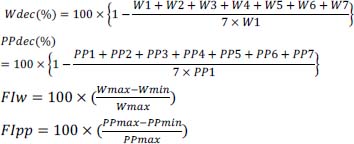
The test metrics include peak power output (PP) during exercise, average power output (AP), total work done (W), as well as decrement scores and fatigue indices for both total work and peak power (Wdec, PPdec, FIw, FIpp). The specific formulas for calculating are as follows:
|
| Central nervous system fatigue test |
The test parameter is critical flicker fusion frequency, measured using the BD-II-118 model (Serial Number: 21013096). Equipment parameters were set as follows before testing: light intensity (1/2), light-dark ratio (1:1), background light (0), color selection (white). The test involved recording two values for each trial (ascending trial starting from 12 Hz, increasing frequency until the subject indicated the light point changed from flickering to non-flickering; descending trial starting from 50 Hz, ending when the subject indicated the light point began to flicker). The average of the two test results was taken. |
| Autonomic nervous system state test |
Heart rate variability (HRV) was recorded continuously from resting state to 10 minutes post-exercise using a Polar V800 heart rate monitor and Polar H7 heart rate sensor. Data were exported from the Polar Flow website for a 5-minute duration at specified time points during the day and analyzed using Kubios HRV Standard software (version 3.5; Kubios Oy, Kuopio, Finland). Ectopic beats and artifacts were automatically detected and corrected using the software's built-in correction algorithm prior to spectral analysis. Key indicators included time-domain metrics (SDNN, RMSSD), frequency-domain metrics (HF(ms2), LF/HF), and nonlinear metrics (SampEn, DFAα1). |
| Lactate metabolism test |
The indicator is blood lactate, measured three times: baseline values in a resting state before exercise, approximately 3 minutes after exercise, and 10 minutes into the post-exercise rest period. German Lactate Scout 4 analyzer and blood lactate test strips were used for analysis, ensuring the first drop of blood was wiped away to prevent contamination. |
| Perceived Exertion (RPE) test |
RPE was recorded seven times, with an immediate confirmation of the level after each sprint. The Borg scale, developed by Swedish psychologist Borg ( |
| Statistical analysis |
The statistical data are presented as mean ± standard deviation (M ± SD). Data analysis was conducted using SPSS 26.0 software. Shapiro-Wilk and Levene tests were employed for normality and homogeneity of variance checks, respectively. Paired-samples t-tests were utilized to compare the mean differences in heart rate variability, critical flicker fusion frequency, blood lactate levels, and subjective fatigue perception among participants between pre-exercise, mid-exercise, post-exercise, and 10 minutes of rest. For the data obtained from the seven repeated sprints, a two-way repeated measures analysis of variance (ANOVA) was performed to assess the main effects (hydrogen-rich water and time) and their interaction on power output and subjective fatigue perception. Because of the crossover design, both condition (HRW vs. placebo) and sprint number were treated as within-subject factors using a fully within-subject error structure. Post-hoc comparisons were carried out using the Bonferroni method when a significant main effect was observed. Effect sizes were evaluated using Cohen's d and η2, with Cohen's d classified as small (≥ 0.20), medium (≥ 0.50), and large (≥ 0.80), and η2 categorized as small (≥ 0.01), medium (≥ 0.06), and large (≥ 0.14) (Cohen, |
|
|
| Impact of hydrogen-rich water consumption on repeated sprinting performance |
The results of paired-samples t-tests ( A fully within-subject two-way repeated-measures ANOVA (condition × sprint) was conducted for peak power (PP), average power (AP), and total work (W). A significant main effect of sprint was observed for all three variables (PP: F(6, 72) = 47.69, p < 0.001, ηp2 = 0.80; AP: F(6, 72) = 57.74, p < 0.001, ηp2 = 0.83; W: F(6, 72) = 54.89, p < 0.001, ηp2 = 0.82), reflecting progressive fatigue across sprints. A significant main effect of condition was found for AP (F(1, 12) = 4.81, p = 0.049, ηp2 = 0.29), indicating higher average power in the HRW condition, whereas the condition main effect did not reach significance for PP (F(1, 12) = 1.30, p = 0.276, ηp2 = 0.10) or W (F(1, 12) = 3.21, p = 0.099, ηp2 = 0.21). No condition × sprint interaction was significant (PP: F(6, 72) = 0.50, p = 0.807; AP: F(6, 72) = 0.60, p = 0.733; W: F(6, 72) = 1.52, p = 0.184). The condition main effect for AP was consistent with the paired-samples comparison (p = 0.049), and aggregate paired t-tests yielded p-values identical to the corresponding ANOVA condition effects, confirming the fully within-subject model specification. |
| Effects of hydrogen-rich water consumption on neural system status |
In terms of heart rate variability time-domain indices, RMSSD was significantly higher in the experimental trial compared to the control trial within 5 minutes after exercise cessation (p = 0.045, d = 0.62). Regarding frequency-domain indices, no significant between-trial differences were observed in HF power. However, the LF/HF ratio was significantly lower in the HRW trial compared to the PW trial at 10 min post-exercise (p = 0.012, d = 0.82). Among nonlinear indices, SampEn was significantly higher in the experimental trial than the control trial 10 minutes after exercise (p = 0.015, d = 0.79), while DFAα1 was significantly lower in the experimental trial than the control trial in the same period (p = 0.047, d = 0.61). No significant differences in heart rate were observed between the two trials at various measurement time points (p > 0.05). Simultaneously, no significant differences were found in the critical flicker fusion frequency between the two trials at different measurement time points (p > 0.05) ( |
| Influence of hydrogen-rich water consumption on metabolic profile |
Pre-exercise ingestion of hydrogen-rich water significantly influenced blood lactate concentration at 3 minutes post-exercise, with the experimental trial (hw) exhibiting a reduction of approximately 1 mmol/L compared to the control trial (pw) (p < 0.05, d = 0.64). However, 10 minutes into the rest period, there was no significant difference in blood lactate concentration between the two trials ( |
| Effects of hydrogen-rich water consumption on perceived exertion |
The subjective fatigue perception during repeated sprinting did not exhibit a significant difference between the experimental trial (hw) and the control trial (pw) (p > 0.05). Simultaneously, the fully within-subject ANOVA revealed a significant main effect of sprint (F(6, 72) = 91.01, p < 0.001, ηp2 = 0.88), whereas neither the main effect of condition (F(1, 12) = 0.007, p = 0.936, ηp2 = 0.001) nor the condition × sprint interaction (F(6, 72) = 1.26, p = 0.286, ηp2 = 0.10) was significant. |
|
|
This study provides the first comprehensive evaluation of the effects of acute HRW ingestion on neurophysiological and metabolic responses during and after repeated sprint exercise in male university athletes. The paired-samples t-tests revealed significant improvements in mean AP and reductions in Wdec and FIw with HRW, indicating that HRW attenuated cumulative power decline across the sprint bout. The fully within-subject ANOVA confirmed a significant condition main effect for average power (p = 0.049), consistent with the paired-samples comparison, whereas peak power and total work showed the same direction without reaching significance, indicating that HRW most clearly benefited sustained average power output across the sprint bout. Simultaneously, ANS regulatory balance recovered more rapidly after exercise, and blood lactate concentration was significantly lower at 3 min post-exercise, collectively reflecting a reduced overall fatigue burden. One of the noteworthy findings in this study is the substantial reduction in the overall power decline during seven repeated sprints with the intake of hydrogen-rich water, corroborating Botek et al.'s ( Concurrently, a notable decrease in blood lactate concentration was observed after hydrogen-rich water intake, signifying its crucial implications for understanding athlete recovery and subsequent performance. Previous research has also indicated that hydrogen-rich water intake effectively inhibits lactate production during high-intensity exercise (Drid et al., Another key finding in the study is the significant acceleration of post-exercise heart rate variability (HRV) recovery following hydrogen-rich water intake. Given that high-intensity intermittent exercise often leads to parasympathetic suppression, resulting in prolonged HRV recovery times(Sousa et al., However, the specific mechanisms by which hydrogen influences exercise and recovery capabilities remain unclear. We speculate on the following potential pathways: (1) Free Radical Scavenging: Hydrogen may directly or indirectly selectively scavenge harmful free radicals, thus protecting cells and maintaining normal function (Ohsawa et al., |
| Limitations |
Several limitations should be considered when interpreting these results. First, the relatively small sample size (n = 13) limits statistical power, particularly for interaction effects in the ANOVA. Based on the a priori analysis, the enrolled sample provided adequate power only for large effects (d ≈ 0.80); the study was therefore likely underpowered to detect smaller between-condition differences, and non-significant findings should be interpreted with this in mind. Second, participants were exclusively male university athletes, restricting generalizability to female athletes, older populations, or elite competitors. Third, the study used a single-blind design: although participants were blinded, the investigators who prepared the beverages were not, which is a potential source of bias; future studies should adopt a fully double-blind design. Fourth, dissolved hydrogen concentration in the water was not verified immediately prior to each ingestion session; any concentration decay between preparation and consumption could reduce the actual H2 dose received. Fifth, no direct biomarkers of oxidative stress (e.g., malondialdehyde, superoxide dismutase) were measured, preventing mechanistic conclusions. Sixth, CFF lacks sensitivity for detecting short-duration CNS fatigue; future studies should incorporate complementary central fatigue measures. Seventh, post-exercise HRV acquisition partially coincided with fingertip lancet punctures for lactate analysis. This procedural coupling likely introduced transient nociceptive-induced sympathetic activation and erratic breathing patterns, which may bias HRV outcomes despite consistent application of Kubios artifact correction algorithms. Future research should expand to diverse exercise modalities, include female cohorts, verify H2 concentration at point of consumption, and incorporate oxidative stress biomarkers to elucidate the underlying mechanisms. |
|
|
Ingesting hydrogen-rich water enhanced overall performance during repeated sprint exercise. Specifically, HRW improved repeated sprint ability by maintaining higher average power output and effectively reducing the magnitude of power decline across sprints. Notably, no significant effect was observed on peak power, indicating that HRW supports sustained rather than maximal single-sprint power. Short-duration repeated-sprint exercise caused significant peripheral fatigue and autonomic disruption. HRW consumption facilitated post-exercise parasympathetic restoration and improved lactate metabolic capacity, indicating that hydrogen supplementation effectively supports autonomic and metabolic recovery after high-intensity exercise. |
| ACKNOWLEDGEMENTS |
We are grateful to the study participants for their cooperation and willingness to participate. The laboratory technicians at 618 Laboratory are thanked for their great dedication, skilled assistance and coordination. Yankang.Jiang, is thanked for his assistance in providing the critical flicker fusion frequency equipment. Special thanks to Guangzhou Yuanshui Environmental Protection Technology Co., Ltd. for providing the equipment used to prepare hydrogen-rich water in this study. It must be emphasized that this provision does not affect the objectivity and scientific rigor of the experiment. No other authors have a conflict of interest to declare. The datasets generated during and/or analyzed during the current study are not publicly available, but are available from the corresponding author who was an organizer of the study. |
| AUTHOR BIOGRAPHY |
|
| REFERENCES |
|
Email link to this article




 Abreu, R.M.d., Rehder-Santos, P., Simões, R.P., Catai, A.M. (2019) Can high-intensity interval training change cardiac autonomic control? A systematic review. Brazilian Journal of Physical Therapy 23, 279-289.